## A Schoolhouse That Holds a City’s Memory
In Clinton, Tennessee, the story of school desegregation is not preserved as an abstraction. It has walls, windows, rooms, and a hillside. It lives inside the former Green McAdoo School, once the segregated elementary school for the city’s Black children during the Jim Crow era. Today, that building is the Green McAdoo Cultural Center, a museum and memorial devoted to one of the most consequential civil-rights stories in Tennessee history: the desegregation of Clinton High School by twelve Black students in 1956.
The setting matters. Before it became a cultural center, Green McAdoo was part of the system that defined everyday life under segregation. Black children in Clinton began their education there because the law, custom, and power structure of the time demanded separation. The building stood within a community where race determined which school a child could enter, which door they could pass through, and what kind of future others expected them to accept. It was a place of learning, but also a reminder of imposed boundaries.
The museum now turns that history back on itself. Inside, photographs, documents, oral histories, and carefully arranged exhibits guide visitors through the world that produced the Clinton 12. The displays do not present desegregation as a simple legal milestone or a distant achievement completed by a court decision. They show it as something lived in the bodies and choices of young people—students who had to walk into a hostile world carrying books, fear, dignity, and the weight of a federal order.
At the center of the Green McAdoo Cultural Center is the story of those twelve students: Jo Ann Allen Boyce, Bobby Cain, Gail Ann Epps Upton, Ronald Hayden, Minnie Ann Dickey Jones, William Latham, Alvah McSwain, Maurice Soles, Robert Thacker, Regina Turner, Alfred Williams, and Theresa Blair. Their names are not footnotes. They are the spine of the museum’s narrative. They were children and teenagers asked by history to do what adults, institutions, and courts had argued over for years: enter a school that had previously excluded them because they were Black.
Their story unfolded after the Supreme Court’s landmark 1954 decision in *Brown v. Board of Education*, which declared racial segregation in public schools unconstitutional. That ruling changed the legal foundation of American education, but it did not automatically open schoolhouse doors across the South. In many communities, resistance was immediate and fierce. Lawsuits, delays, local defiance, and public intimidation slowed the promise of Brown. The ruling required enforcement. It required local cases, federal judges, and, ultimately, young people willing to step into places where they had been told they did not belong.
In Clinton, that enforcement came through a federal court order. In January 1956, U.S. District Judge Robert L. Taylor ordered Anderson County, Tennessee, to integrate Clinton High School. The decision placed Clinton at the forefront of the desegregation struggle in the South. It also placed a direct burden on twelve Black students from the city’s Black community, Foley Hill. They would be the ones to transform a ruling on paper into a visible reality.
The Green McAdoo Cultural Center preserves that transformation with a deliberate sense of place. It stands not merely as a repository of objects, but as a witness. Its exhibits ask visitors to consider what it meant for students educated under segregation to leave the security of their own neighborhood and enter a high school where their presence challenged generations of racial order. The museum holds the quiet tension between law and life: between the authority of a federal court and the rage of those who refused to accept it.
To walk through the center is to encounter a story that begins in classrooms but expands outward into streets, courtrooms, state power, mob resistance, and public memory. It is a Tennessee story, but also a national one. It belongs to the broader history of school desegregation, to the unfinished work of Brown, and to the long civil-rights struggle in which ordinary people—often very young people—became the instruments of constitutional change.
## The Walk from Foley Hill
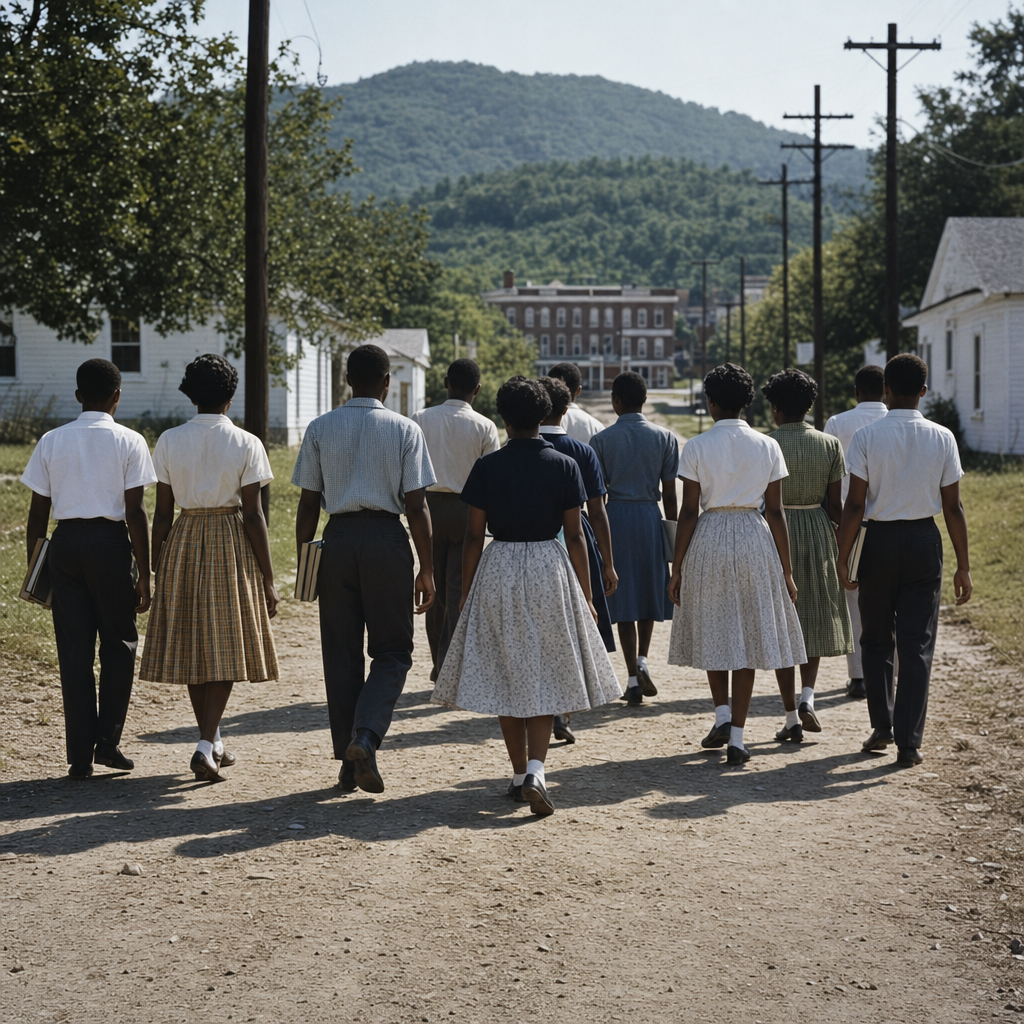
On August 27, 1956, twelve Black students walked from Foley Hill toward Clinton High School. The distance was physical, but it was also historical. They were moving from a segregated Black neighborhood toward a previously all-white institution, from the familiar toward the unknown, from the margins of a system into its guarded center. Their walk was the visible beginning of Clinton High School’s desegregation.
The names of the Clinton 12 deserve to be spoken with care: Jo Ann Allen Boyce, Bobby Cain, Gail Ann Epps Upton, Ronald Hayden, Minnie Ann Dickey Jones, William Latham, Alvah McSwain, Maurice Soles, Robert Thacker, Regina Turner, Alfred Williams, and Theresa Blair. Together, they became among the first Black students in the South to desegregate a public high school under court order. They did not do so as symbols first. They did so as students. They were seeking an education.
That distinction is central to the power of the story. The Clinton 12 were not entering a battlefield by choice, yet the path before them became one. Their enrollment at Clinton High was the result of a federal order issued months earlier by Judge Robert L. Taylor, but the order itself could not shield them from the hostility waiting beyond the law. Brown v. Board had established that segregated public schools violated the Constitution. Judge Taylor’s order applied that principle to Anderson County. But neither a Supreme Court ruling nor a district court order could erase prejudice overnight. The students had to face what remained.
Their walk from Foley Hill has endured because it compresses the civil-rights struggle into a single, unforgettable image: young people moving forward. They carried the expectations of their families and community. They also carried the scrutiny of a town, a state, and a region watching to see whether desegregation would happen in practice. The act was simple in form—walking to school—but enormous in meaning. It exposed the difference between legal change and social acceptance.
Clinton High School’s desegregation placed the city in a tense and volatile position. Across the South, white resistance to school integration often relied on delay, intimidation, and public spectacle. Clinton was no exception. The students’ first days were not marked by ordinary routines alone. Their presence drew the attention of segregationist agitators, including John Kasper, who came to Clinton and helped inflame crowds. What had begun as compliance with a federal court order became a flashpoint.
The Green McAdoo Cultural Center’s interpretation of this moment places the students at the center rather than the mobs around them. That is important. The violence and resistance cannot be ignored, but neither should they be allowed to define the students only as victims. The Clinton 12 were participants in history, and their courage was not theatrical. It was daily. It consisted of returning, enduring, stepping through doors, sitting in classrooms, and continuing their education under pressure.
The museum’s use of photographs and oral histories helps bridge the distance between then and now. A visitor looking at images of the students can recognize the ordinary details of youth: faces still forming, expressions holding seriousness beyond their years, clothing chosen for school, posture shaped by both vulnerability and resolve. Documents provide the structure of the story—the court order, the timeline, the official record. Oral histories bring breath back into it. Together, they remind us that desegregation was not a single event but a lived experience made of mornings, confrontations, decisions, and consequences.
Foley Hill remains essential to understanding the story. It was the community from which the students came, the place that gave them their starting point. Their walk to Clinton High was not merely a route across town. It was a crossing between two realities created by segregation. On one side stood the world of Black education under Jim Crow, represented by places such as Green McAdoo School. On the other stood a public high school that had been reserved for white students. The Clinton 12 moved between those worlds and, by doing so, challenged the legitimacy of the boundary itself.
That is why the walk has become the defining image of the Clinton story. It was not dramatic because of distance. It was dramatic because of what the students confronted with every step: the refusal of a community’s segregationist order to yield peacefully, the uncertain protection of law, and the knowledge that their presence would be watched, judged, and opposed. The students walked anyway.
## Violence, Resolve, and a School in Ruins
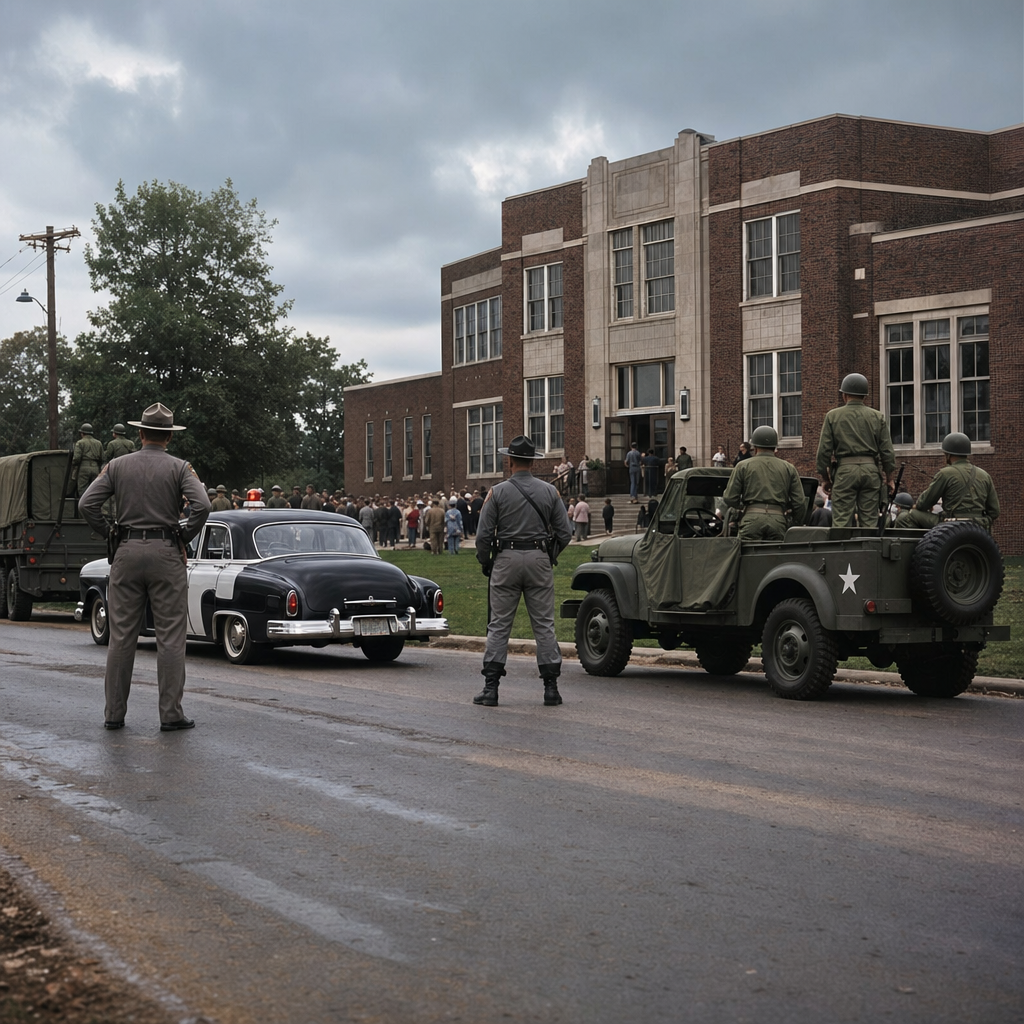
The desegregation of Clinton High School did not proceed quietly. After the Clinton 12 enrolled, resistance intensified. Segregationist agitators, including John Kasper, helped stir anger and swell crowds. The atmosphere in Clinton grew dangerous enough that Tennessee Governor Frank G. Clement sent state troopers and the Tennessee National Guard to restore order in early September 1956.
The arrival of state authority underscored how high the stakes had become. A public high school had opened its doors under federal court order, and the result was not simply disagreement but unrest severe enough to require intervention. The presence of troopers and the National Guard revealed the fragile line between constitutional law and local defiance. In Clinton, that line had to be physically defended.
For the Clinton 12, the conflict was not theoretical. The hostility surrounding desegregation became part of their school experience. Harassment followed them. Crowds and agitation turned education into an ordeal. The students were not only trying to attend classes; they were forced to navigate the emotional and physical pressure of being unwanted by many who believed the school should remain segregated.
Yet the story is also one of persistence. The students’ continued presence at Clinton High kept the federal order alive in practice. Every day they remained was an answer to the attempt to drive them away. The civil-rights struggle often required this kind of endurance: the ability to withstand pressure not in a single heroic instant, but through repetition. Returning again. Sitting again. Learning again. Refusing to vanish.
One of the clearest markers of that endurance came in 1957, when Bobby Cain graduated from Clinton High School. His graduation made him one of the first Black students to graduate from a formerly all-white public high school in the South. The significance of that moment reaches beyond one diploma. It demonstrated that desegregation could be more than an opening-day event. A Black student had entered, remained, completed the required work, and graduated from a school that had once excluded him.
Graduation, in this context, was not ceremonial alone. It was evidence. It showed that the argument for exclusion had always been hollow. Bobby Cain’s achievement stood against the claim that Black students did not belong in white schools, against the intimidation designed to force them out, and against the system that had tried to assign educational opportunity by race. In the history preserved at Green McAdoo, his graduation carries the force of a public answer: the students did belong. They had always belonged.
Still, the struggle in Clinton did not end with the first year of desegregation or with Cain’s graduation. On October 5, 1958, Clinton High School was destroyed by dynamite. The bombing shocked the region. A school building—already a contested symbol of federal authority, local resistance, and Black students’ rights—was reduced to wreckage by an act of violent destruction.
The bombing revealed the depth of opposition that still surrounded desegregation. It also transformed the physical landscape of the conflict. Clinton High was no longer only the site of integration; it became the site of an attack meant to obliterate the institution itself. The destruction of the school was a violent attempt to halt or punish change, but it did not erase the movement that had already begun. Students continued their education in temporary locations while the school was rebuilt.
That detail is crucial: classes continued. The bombing created disruption, but not finality. The school community had to adapt, relocate, and persist. In 1960, a new Clinton High School opened. The rebuilt school stood as a material answer to the dynamite that had destroyed the earlier building. It marked continuation after violence, reconstruction after rupture.
The arc from August 1956 to the opening of the new Clinton High in 1960 contains the stark realities of Southern school desegregation. There was a Supreme Court ruling, then a federal court order, then the walk of twelve students, then harassment and mob resistance, then intervention by the governor through state troopers and the National Guard, then graduation, then bombing, temporary classrooms, and rebuilding. The sequence resists simplification. It was not a clean march from injustice to justice. It was contested at every stage.
The Green McAdoo Cultural Center preserves that complexity. It does not allow the story to be softened into a single triumphal image. The bronze figures outside honor the walk, but inside the exhibits also carry the strain, danger, and aftermath. They show that the Clinton 12 were part of a broader fight for school desegregation in which the law could declare rights, but communities had to be forced—or persuaded, or compelled by courage—to recognize them.
In Clinton, courage had young faces. It wore school clothes. It walked from Foley Hill. It entered Clinton High under court order. It endured harassment. It witnessed the power of resistance and the necessity of enforcement. And even after dynamite destroyed the school building, the story continued.
## Bronze, Photographs, and the Work of Remembering
Today, the Green McAdoo Cultural Center stands as both a museum and a public memorial. Its purpose is not only to preserve objects, but to shape memory—to ensure that the Clinton 12 are remembered in the place where their courage changed history. The former Green McAdoo School, once a segregated elementary school for Black children, now interprets the struggle that helped dismantle the very system it once served.
The transformation of the building is powerful. A school created within Jim Crow now houses the record of those who challenged Jim Crow’s educational order. Rooms that once belonged to segregated schooling now invite visitors to study desegregation. The building has become a vessel of reversal: what was once part of a divided system now teaches the cost of division and the courage required to confront it.
Inside, the museum uses photographs, documents, oral histories, and exhibits to place the Clinton 12 within the broader fight for school desegregation. This approach matters because the Clinton story is both local and national. It belongs to Clinton, to Anderson County, to Tennessee. But it also belongs to the wider history of Brown v. Board of Education and the long effort to make constitutional rights real in classrooms across the South.
The photographs offer immediacy. They narrow the distance between the visitor and the students, reminding us that history was lived by individuals, not categories. The documents provide the framework of law and chronology: the 1954 Supreme Court decision, the January 1956 order by U.S. District Judge Robert L. Taylor, the enrollment at Clinton High on August 27, 1956, the state response in early September, Bobby Cain’s graduation in 1957, the bombing on October 5, 1958, and the opening of a new Clinton High in 1960. Oral histories add human texture, preserving memory in voices rather than only in official records.
Together, these materials show how desegregation required more than a ruling. Brown v. Board declared segregated public education unconstitutional, but implementation depended on people and places. It depended on judges willing to issue orders, state officials willing to enforce order, families willing to let their children walk into danger, and students willing to bear what no student should have had to bear. The Clinton 12 stand at the center of that process because they made the law visible.
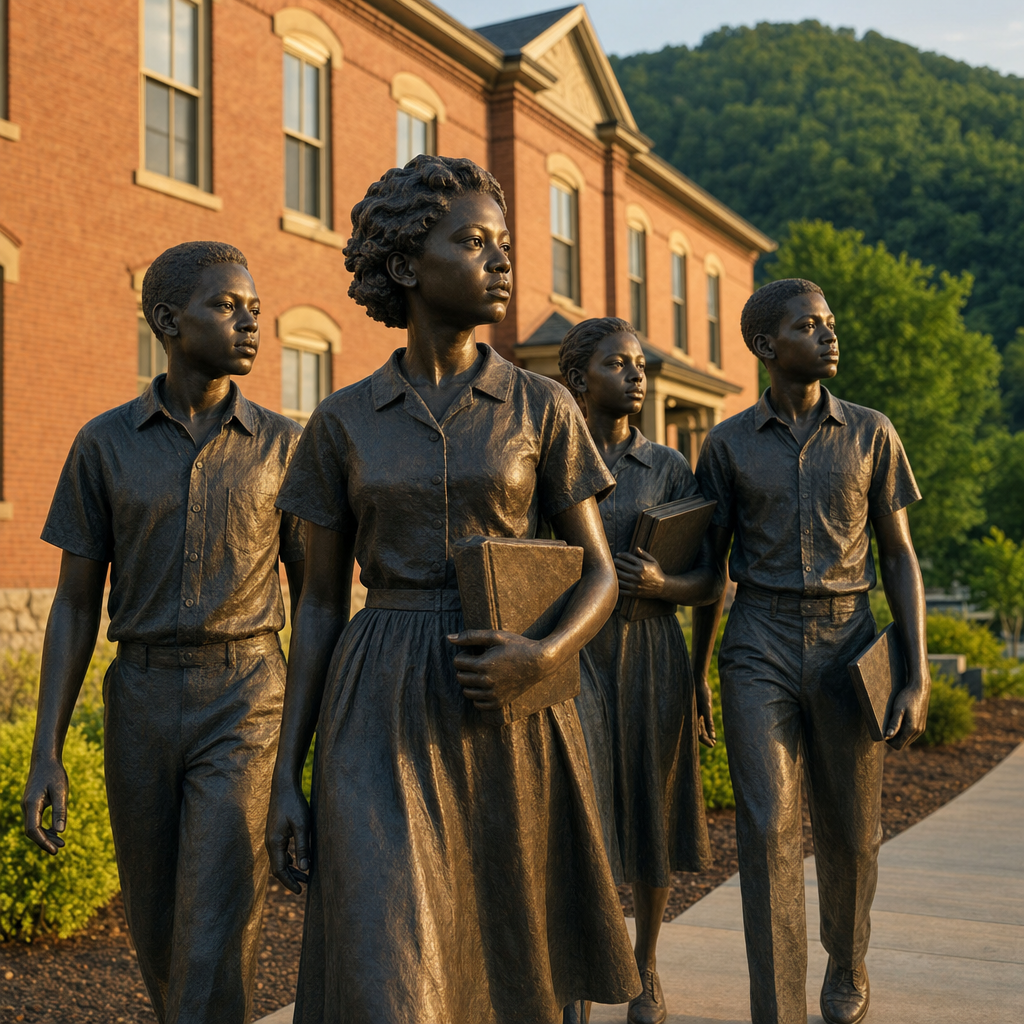
Outside the center, life-size bronze figures depict the students as they began their walk toward Clinton High. The memorial gives form to motion. The figures do not show a distant battlefield or a formal ceremony; they show students walking to school. That is the enduring power of the site. It asks visitors to stand near the beginning of that walk and imagine the meaning of each step.
Bronze changes the moment into something permanent, but the sculpture’s subject remains deeply human. The students are represented not as unreachable icons, but as young people moving forward together. The memorial holds the tension between vulnerability and determination. It honors the fact that their courage was enacted in public, under pressure, in a community where many opposed them. By placing the figures outside, the center extends the museum into the landscape. The story is not confined behind glass. It occupies public space.
The Green McAdoo Cultural Center also serves as a reminder that civil-rights history is often preserved most powerfully in the places where it happened. National narratives can flatten local struggle, turning complex communities into brief examples. Clinton’s story resists that. The museum insists on names, dates, streets, schools, and consequences. It remembers Foley Hill. It remembers Clinton High. It remembers the federal order and the mobs. It remembers the governor’s intervention, the National Guard, the harassment, the graduation, the bombing, the temporary classrooms, and the rebuilding.
Most of all, it remembers the students.
Jo Ann Allen Boyce. Bobby Cain. Gail Ann Epps Upton. Ronald Hayden. Minnie Ann Dickey Jones. William Latham. Alvah McSwain. Maurice Soles. Robert Thacker. Regina Turner. Alfred Williams. Theresa Blair.
Their names anchor the story against forgetfulness. Without them, desegregation can become a policy term, a chapter heading, a legal outcome. With them, it becomes what it was: a human test of democracy. The Clinton 12 did not write the Brown decision. They did not issue the federal court order. They did not summon the hostile crowds or choose to become symbols in a regional conflict. But when the moment came, they walked.
The Green McAdoo Cultural Center preserves that walk not as a completed past, but as a living memory. It asks what it means for children to carry the burden of rights denied by adults. It asks how a nation’s highest ideals move from paper into practice. It asks visitors to consider the distance between a court ruling and a classroom desk—and the courage required to cross it.
In Clinton, that distance began at Foley Hill and led to Clinton High School. It passed through fear, resistance, state intervention, and violence. It also led to graduation, rebuilding, and remembrance. The former Green McAdoo School now holds the story so that the walk of the Clinton 12 remains visible: twelve students stepping into history, and a community still called to remember what their steps made possible.