## The Little Shop Called the Béjé
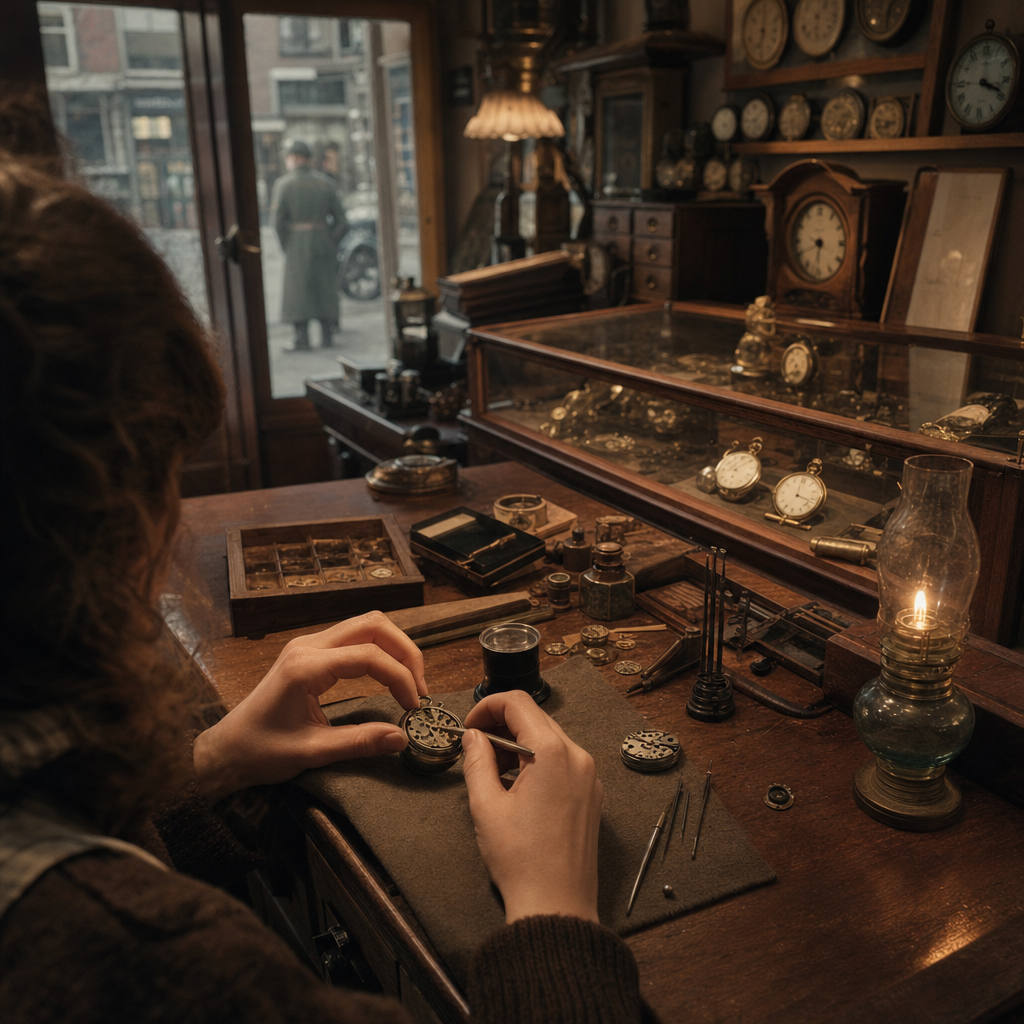
At Barteljorisstraat 19 in Haarlem, in a narrow Dutch street not far from the rhythms of everyday town life, there stood a watch shop that people knew by a friendly little nickname: the Béjé. The name came from the initials of the street itself, and it suited the place. It sounds almost like something you would say with affection, the way families and neighbors do when a house becomes more than an address.
Haarlem was only a short train ride from Amsterdam, close enough to the great city to feel connected to its bustle, but the Béjé belonged to its own world: the world of clocks, repairs, counters, customers, and the patient work of measuring time. Inside, the shop was practical before it was anything else. Watches needed mending. Clocks needed setting. Customers came and went. Hands moved across dials. Springs, gears, faces, chains, and careful tools made up the ordinary music of the place.
And at the heart of that life was the Ten Boom family.
Corrie ten Boom was part of this household and this trade. In 1922, she became one of the first licensed women watchmakers in the Netherlands, a detail that still feels bright and striking. It tells us something about her, without needing to announce it too loudly. She was skilled. She was steady-handed. She knew how to attend to small mechanisms, to listen for what was not quite right, to restore order to delicate things.
Watchmaking is humble work in one sense: a person leans over a table, concentrates, and handles pieces so small they can nearly disappear. But it is also work full of trust. People bring you the instruments by which they organize their days. A watch is practical, yes, but also intimate. It touches a wrist, sits close to the body, keeps appointments, marks departures and arrivals, measures waiting and relief.
So the Béjé was not a grand stage. It was a shop and a home. It was full of ticking. It had customers at the counter. It had family life upstairs and work downstairs. If someone had walked in before the war, they might simply have seen an orderly place where clocks were repaired and time was taken seriously.
That ordinariness matters.
Because later, during the German occupation, the most remarkable piece of timing in the house was not a clock. It was not an elegant watch, newly repaired and shining under the shop light. It was not a pendulum keeping dignified pace in a room. It was a drill.
A drill, in the most human sense: practice. Repetition. A signal, a rush, a breath held, a body moving quickly through a house. A drill that took fear and gave it a shape. A drill that said: when the alarm comes, here is what we do. Here is how we keep one another alive.
The story of the Béjé can easily be told as a story of danger, and of course it is that. German occupation made ordinary kindness perilous. A house that opened its doors became a house under threat. A room could become evidence. A cup could become a clue. A stranger’s coat could betray a life. Everything normal could suddenly matter in terrible ways.
But it is also a story of habits. Of people learning what love required in real time. Not love as a feeling floating above life, but love as footsteps on stairs, hands clearing a table, a door closed behind someone, an object put back exactly where it belonged.
That is part of what makes the Béjé so unforgettable. The heroism there did not always look heroic. Sometimes it looked like tidying up quickly. Sometimes it looked like listening for an alarm. Sometimes it looked like knowing that if you were holding a cup, you might have to set it down—or better yet, make sure it vanished with you. Sometimes it looked like learning the house so well that fear would not paralyze you when seconds mattered.
And in a watchmaker’s home, seconds mattered.
## The Room Behind the Wall
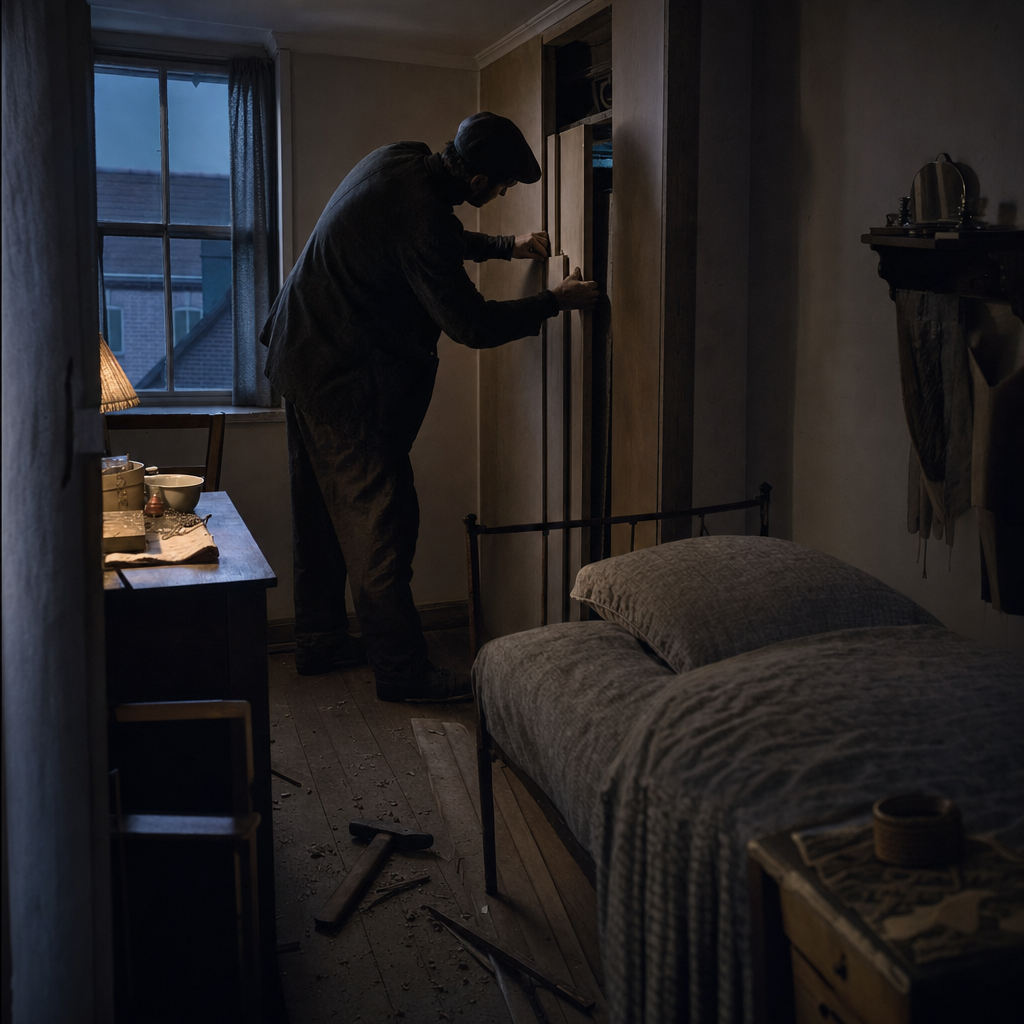
During the German occupation, a hiding place was built in Corrie’s small bedroom, behind a false wall. In Corrie’s account, the resistance architect who built it is known as Mr. Smit. Even that detail has a quietness to it: a name from an account, a figure associated with construction, planning, and secrecy. He made a space that was meant not to be seen.
A false wall is a strange thing to imagine in a bedroom. A bedroom is usually the place in a house most associated with rest, privacy, and the unguarded self. It is where shoes are left beside a bed, where a person wakes and dresses, where the day begins and ends. But in Corrie’s small bedroom, the wall carried another purpose. Behind it was a narrow hiding place, a secret space that could hold life in a moment of danger.
Yet the wall itself was only part of the answer.
That is one of the most important things to understand. A hidden room sounds, at first, like the whole solution. Build it well enough, conceal it cleverly enough, and perhaps people will be safe. But a hiding place is not magic. It does not gather people into itself automatically. It does not erase the signs they leave behind. It does not silence a room or clear a table or straighten a chair. It does not make ordinary people invisible unless those ordinary people know how to disappear into it.
So the Ten Boom household practiced.
That word may feel almost too plain for what was at stake. Practiced. Like children practicing scales on a piano. Like a tradesperson practicing a difficult repair. Like a person rehearsing a speech or learning a step. But practice was the hinge between danger and survival.
When the alarm sounded, anyone who needed to hide had to move at once. There was no time for discussion. No time to finish a sentence. No time to gather belongings slowly or look around in panic. Whatever a person was doing had to be abandoned. Then came the hurry upstairs, the slip through the opening, the closing away of visible presence.
And then came the other part, just as crucial: the house had to tell no story.
No extra cup. No stray belonging. No sign that more people had been there than should have been. The rooms had to look ordinary. The objects had to behave like innocent objects. A visitor looking around should not be able to count invisible guests from the evidence they left behind.
That is a chilling thought, but also an oddly domestic one. We tend to think of rescue in large gestures, but here rescue depended on the small grammar of household life. A cup on a table. A coat in the wrong place. A chair pulled out. A personal item forgotten in haste. In peaceful times these things are nothing. In occupied Haarlem, inside the Béjé, they could matter terribly.
So the drill became part of life.
Imagine the awkwardness of those first attempts. People trying to move fast through familiar rooms suddenly made unfamiliar by fear. Someone turning the wrong way. Someone forgetting something. Someone making too much noise. Someone perhaps nervous enough to laugh for half a second, because human beings sometimes do that when fear and absurdity meet in the same room. And then everyone trying again.
There is something deeply human in practice. It admits that courage does not always arrive fully formed. It says: we may be frightened, we may be clumsy, we may not get it right the first time, but we can learn. We can train our bodies to do what our hearts have already chosen. We can prepare for the moment we hope never comes.
Corrie later wrote that they learned to do it in about 70 seconds.
Seventy seconds.
Not even a minute and a half. Barely enough time to boil water, to tie shoes slowly, to read a short note, to look out a window and gather your thoughts. Seventy seconds is both astonishingly brief and, in danger, unbearably long. It is the length of a held breath stretched almost to breaking. It is the span in which people upstairs and downstairs had to become a different household: from visible to hidden, from crowded to ordinary, from endangered to perhaps safe.
And again, the number is so specific that it catches in the mind. Not “quickly.” Not “in a short time.” About 70 seconds. The watchmaker’s world seems to hover around it. Time is not abstract in that house. It has weight, sound, urgency. It can be measured. It can be improved. It can be practiced.
The Béjé had always known ticking. But now the ticking had changed.
## Seventy Seconds of Mercy
There is something almost comic, and deeply human, in that number: 70 seconds. Not comic because anything about the danger was light, but comic in the way life sometimes squeezes the absurd into the middle of terror. A houseful of people, some of them fugitives, some of them neighbors or helpers, all trying to master the choreography of disappearance. When the alarm sounded, up they went. Move, hide, clear, silence. Again. Faster. Again. Better.
It is not the kind of detail that usually sits at the center of grand historical memory. We expect speeches, declarations, uniforms, flags, trumpet calls. We expect the drama of decision. But the Béjé gives us something smaller and in some ways more intimate: a household trying to get its timing right.
That is why the drill matters so much.
It shows that kindness there was not merely an attitude. It had technique. It had muscle memory. It had standards. To care for people in danger meant asking practical questions: Where will they go? How fast can they get there? What will be left behind? Who will notice? What will the room look like afterward? How do we make sure panic does not scatter evidence across the house?
This is mercy with sleeves rolled up.
It is one thing to say, “You may hide here.” It is another thing to arrange your home so that those words have a chance of holding. It is one thing to feel compassion. It is another to let compassion rearrange the furniture, alter the walls, train the household, and discipline the smallest habits of daily life.
And still, the people involved remained ordinary people. That may be the most powerful part. The hiding place did not turn them into characters from legend. The drill did not make them fearless. They were human beings in a home above and around a watch shop, learning a strange routine because the times had become strange and cruel.
Think of the emotional weather in those practice runs. The alarm sounds. Hearts jump. Bodies move. Someone must remember not just to hide, but to erase the signs of having been there. A room must return to itself. The shop must be the shop. The house must be the house. Nothing must look hurried, because hurry itself can be a clue.
The practice asked everyone to trust everyone else. Those slipping through the opening behind the false wall had to trust that the visible rooms would be put right. Those outside the hiding place had to trust that the hidden ones would move quickly and quietly. Everyone had to trust the drill. Everyone had to trust that repetition could hold them when fear arrived.
That is one of the tender things about the number 70. It suggests community. No one person could create those 70 seconds alone. The architecture mattered, yes. Mr. Smit’s hidden space behind the false wall mattered enormously. But architecture alone could not clear a room. Architecture could not make a cup disappear from sight. Architecture could not teach a frightened body the fastest path upstairs.
The household learned together.
There is a kind of humility in that. No one simply assumes they will behave well in crisis. They practice. They accept the possibility of failure before failure can cost lives. They refine. They repeat. In the middle of occupation, under the pressure of danger, they make a routine out of rescue.
The phrase “ordinary people” can become a cliché if we are not careful, but here it is exact. Ordinary people were asked to do something extraordinary in an ordinary setting. The table, the stairs, the bedroom, the wall, the cup—these did not stop being ordinary things. They simply became part of a moral emergency.
And maybe that is why this story stays with people. It does not allow us to keep goodness at a safe distance, imagining that it belongs only to unusually brave souls in unusually dramatic places. The Béjé was a watch shop. Corrie was a watchmaker. Her family’s home had customers at the counter and clocks that needed attention. The secret was hidden inside daily life, not outside it.
The drill reveals a truth that is both beautiful and demanding: care becomes real in details. If someone is hungry, care may be bread. If someone is grieving, care may be sitting quietly nearby. If someone is hunted, care may be a false wall, an alarm, a practiced route, and a room cleared in about 70 seconds.
There is no need to romanticize the fear. The people hiding were in danger. The people helping them were in danger. The German occupation was not a backdrop; it was the force that made the hiding place necessary. The kindness of the Ten Boom household existed under threat. That is part of why the drill feels so moving. It was not symbolic. It was functional. It was meant to work.
And according to Corrie’s later account, they got it down to about 70 seconds.
That number is not polished like a monument. It is practical, almost workmanlike. It sounds like something a watchmaker would respect: a measured improvement, a result achieved through attention. Not perfection in some abstract sense, but enough. Fast enough. Quiet enough. Careful enough.
Enough, they hoped, to save lives.
## The Raid and the Narrow Space
On February 28, 1944, the raid came.
The moment they had practiced for was no longer practice. Corrie, her father Casper, and other family members were arrested. The danger that had been anticipated in drills, imagined in alarms, and prepared for in those careful 70 seconds finally arrived at the door.
But the six people in the secret space were not found.
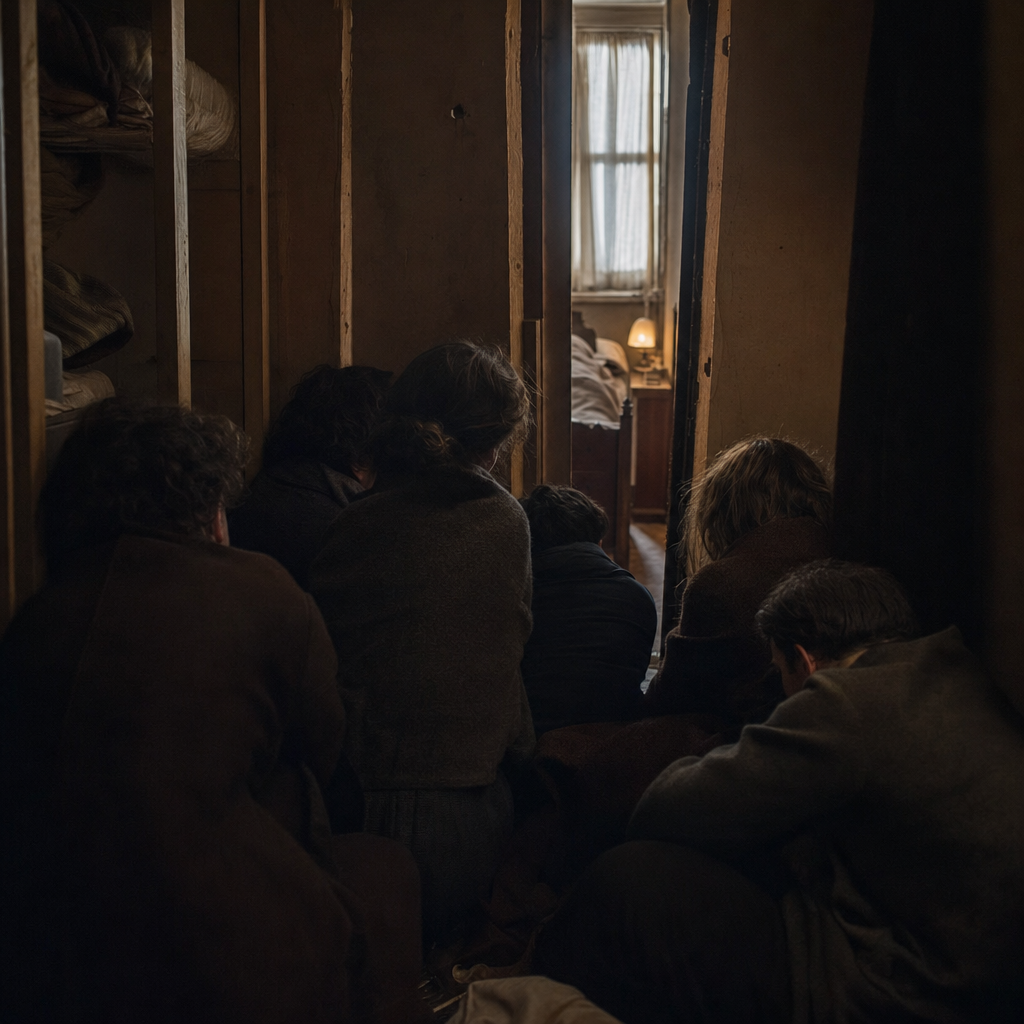
There were four Jewish people and two Dutch resistance workers hidden there, behind the false wall in Corrie’s small bedroom. The raid did not uncover them. The narrow space held. The drill, the wall, the discipline of the household, the disappearance of clues—all of it came to that terrible test.
The six remained hidden for roughly 47 hours.
It is hard to sit with that length of time. Seventy seconds is the rush into hiding. Forty-seven hours is the waiting afterward. Nearly two days in a secret space, not found but not yet free. Time must have felt different there. In a watchmaker’s house, time was usually something measured and repaired, displayed and sold, adjusted and understood. But for those hidden behind the wall, time would have been something endured.
The story gives us the fact: roughly 47 hours passed before members of the resistance helped them out. We do not need to embellish it to feel its weight. Hidden. Unfound. Waiting. Then, finally, helped out by the resistance.
That sequence is simple, but it contains a world.
The raid also reminds us that the hiding place was never a guarantee. It was a risk taken in the hope that preparation could meet danger. The six people were not found, but Corrie, Casper, and other family members were arrested. The house that had sheltered people could not shield everyone from harm. The rescue of some and the arrest of others sit side by side in the same account, inseparable.
That is often how history feels when we let it be honest. Not tidy. Not painless. Not a story in which courage prevents all suffering. The Ten Boom family’s efforts did not make danger disappear. They made room for life inside danger. They created a chance where there might have been none.
And the six hidden people survived the raid because they were not discovered.
Today, the Corrie ten Boom House still lets visitors see the narrow space behind the wall. People can stand there, or near there, and look at what remains visible of the hiding place. It is natural, when seeing it, to notice the danger first. The narrowness. The concealment. The thought of people pressed into silence while a raid unfolded around them. The knowledge that discovery would have meant catastrophe.
But there is another detail worth carrying out of the house, gentler and perhaps even more instructive: the practice.
The practice is easy to overlook because it is not as visually dramatic as a hidden room. You can photograph a wall. You can point to a space. You can show visitors the opening and say, “Here.” But how do you display repetition? How do you exhibit the alarm sounding again and again before the day it mattered? How do you preserve the memory of people learning to move through a home without leaving a trace?
And yet that practice was part of the hiding place. In a sense, the hidden room extended beyond the false wall. It included the stairs, the cups, the belongings, the timing, the habits, the shared understanding of what to do. The hiding place was architectural, but it was also communal. It was built of wood and wall, yes, but also of rehearsal, trust, and care.
Neighbors and fugitives learned a strange household routine. They tried again until 70 seconds was enough. That is such a modest sentence, and it may be one of the most moving ones. They tried again. They practiced not because practice removed fear, but because fear made practice necessary.
The Béjé began as a watch shop, a practical place with ticking clocks and customers at the counter. Corrie ten Boom, one of the Netherlands’ first licensed women watchmakers, knew the value of careful timing in her trade. But during the occupation, timing took on a far more urgent meaning. The household’s kindness had to be measured not in sentiments, but in seconds.
What stays with us, then, is not only the hidden space itself, though that matters deeply. It is the picture of people preparing to protect one another in the most concrete ways. It is the understanding that mercy can be organized. It can be rehearsed. It can learn the route upstairs. It can remember the cup. It can close behind a wall and wait.
In the end, the Béjé’s story asks us to notice the moral beauty of practical things. A false wall. An alarm. A practiced movement. A cleared table. A narrow room. A rescue after roughly 47 hours. These are not abstractions. They are the shapes that courage took at Barteljorisstraat 19.
And in that watchmaker’s home, mercy kept time.