# The Samurai Sword in the Flower Town
At an azalea festival in Brookings, Oregon, a former Japanese wartime pilot arrived with his family’s roughly 400-year-old samurai sword. He expected hard faces, maybe anger, and instead met handshakes, flowers, and the kind of welcome that can make a person blink twice.
Nobuo Fujita had come a long way for that moment. Twenty years earlier, as a Japanese naval warrant officer, he had flown a small floatplane launched from the submarine I-25 and dropped two incendiary bombs in the forest near Brookings. No one was hurt, and the fire was quickly contained, but Fujita had carried the memory with him.
The invitation came from the Brookings Junior Chamber of Commerce, of all places — not a government office, not a courtroom, not a group looking to reopen old wounds. They invited him to the town’s 1962 Azalea Festival.
Brookings had every reason to be wary. The bombs had fallen near their own forest, on their own coast, close enough that people could point toward the place and say, “There.”
Fujita came anyway.
He did not come empty-handed. With him was his family’s samurai sword, about four centuries old, a thing of deep personal meaning. He brought it not as a trophy, but as an offering — an apology made in steel, memory, and humility.
Picture the strangeness of it: festival flowers brightening the town, visitors moving through the celebration, and in the middle of it all a former enemy pilot standing before the people of Brookings with a sword from his family’s past.
But Brookings answered differently.
People welcomed him. They shook his hand. They treated him not as a symbol of the war, but as a man who had come back with sorrow and respect. There was something gently funny in the contrast: Fujita had prepared himself for anger, and Oregon gave him hospitality instead, the emotional equivalent of setting an extra chair at the table.
That welcome did not erase what had happened. The bombs were real. The fear had been real. The forest fire had been real, even if it was quickly contained and no one was injured. But the town chose not to let the hardest part of the story have the final word.
Fujita presented the sword to Brookings as a gesture of apology and peace. It was an extraordinary gift, not because it was old, though it was, and not because it was beautiful, though it surely carried the weight of careful hands and generations. It mattered because he gave something personal to a place he had once attacked, and the place received him with grace.
That meeting became more than a single festival story. Years later, in 1985, Fujita paid for three Brookings-Harbor High School students to visit Japan. The friendship had stretched across the ocean in both directions now, from a small Oregon town to the country of the man who had once flown over it in wartime.
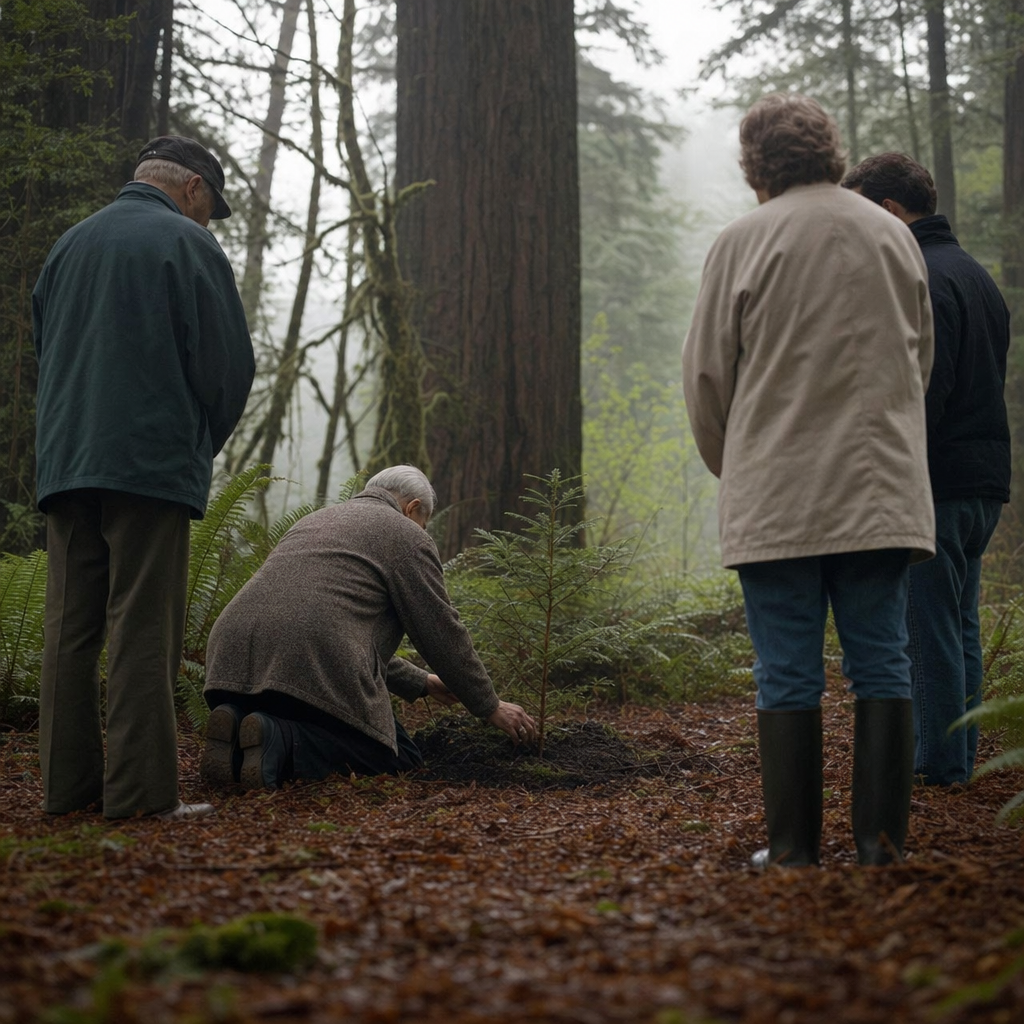
In 1992, he returned again. This time he planted a redwood near the old bomb site, a quiet act in the soil where fire had once been meant to start. A redwood is a patient thing; it does not hurry, which seems right for a friendship that grew slowly from apology, welcome, and repeated visits.
Shortly before Fujita’s death in 1997, Brookings made him an honorary citizen. His sword remains in Brookings, part of a hard story that ended with an open hand instead of a clenched one.
Some towns answer history with flowers.