# The Shop Clerk Who Kept Seeing Paintings
In Charlotte Amalie, the harbor could make a young artist forget the counter in front of him: boats, clouds, hills, and people moving through town, all asking to be drawn. The odd little sweetness is that the future “father of Impressionism” once had a day job in a dry-goods business.
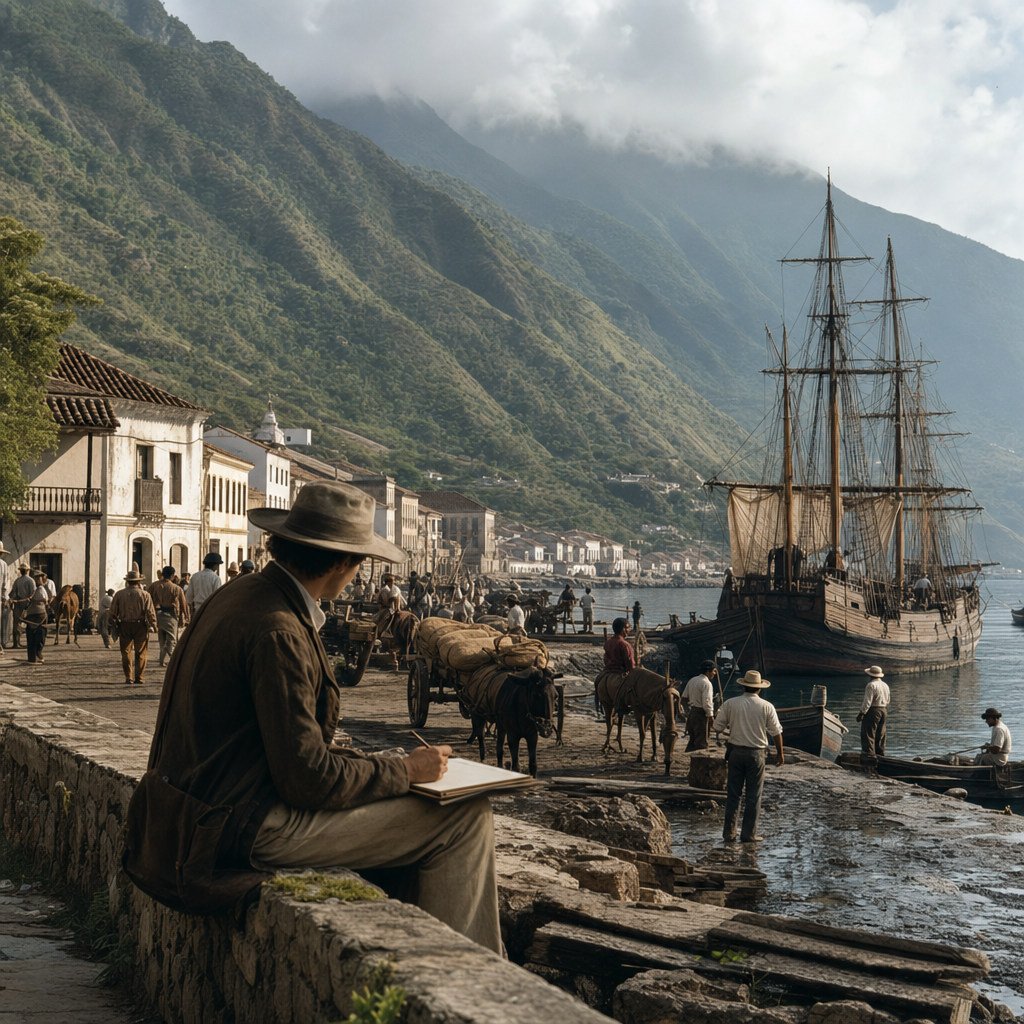
Jacob Abraham Camille Pissarro was born on St. Thomas in 1830, when the island was part of the Danish West Indies. After schooling near Paris, he came home in 1847 and went to work as a clerk in his family’s store. What he wanted kept tugging at him from outside: the harbor, the streets, the market women, the life of Charlotte Amalie passing by in color and motion.
It’s a funny picture, in the gentlest way. There he was, a young man expected to mind the business, while his eye wandered toward clouds and boats instead of bolts of cloth or whatever needed straightening on the shelves. Not mischief. Just art, refusing to sit quietly.
Then Fritz Melbye came through St. Thomas in 1850.
Melbye was a Danish painter, and he saw something in Pissarro’s sketches that mattered. He didn’t wave it off as a hobby or a young man’s daydream. He took it seriously. That small act changed the shape of the room for Pissarro. Suddenly, the drawings weren’t just stolen moments between duties; they were evidence of a real gift.
No grand speech needs to be invented here. The simple fact is strong enough: Melbye recognized Pissarro’s talent and became his mentor.
Imagine what that must have meant to a young clerk with paint and pencil in his mind. Someone who knew the artist’s path looked at his work and, instead of saying, “Get back to the counter,” made room for the possibility that the counter was not the end of the story.
In 1852, Pissarro and Melbye left St. Thomas together for Venezuela. Pissarro spent time drawing and painting in places such as Caracas and La Guaira, carrying with him the eye trained on island streets, sea air, and ordinary people going about their day. The trip did not erase where he came from. It widened what he could see.
Pissarro later returned briefly to St. Thomas, then went on to Paris in 1855. There, the young man who had once worked in the family dry-goods business became part of a new way of painting. He participated in all eight Impressionist exhibitions in Paris, from 1874 to 1886, the only artist to do so.
That makes the early island scenes feel especially dear. They weren’t a childish detour before the “real” work began. They were part of the artist he became: the hills, the harbor, the people in motion, the bright daily life that first taught his eye where to linger.
In Charlotte Amalie, the Pissarro Building, associated with his birthplace, gives the story a hometown sweetness. Before the museums and the art-history books, there was a St. Thomas young man behind a counter, sketching what he couldn’t stop seeing.
And someone kind enough to notice.