# The Juvenile Band That Grew Up Right on Time
Before it was a Navy band, it was youthful noise in Charlotte Amalie trying very hard to become music. You can almost hear the bright, brave notes of a cornet rising above the practice-room wobble, the sound of boys learning that “again” was a perfectly normal part of rehearsal.
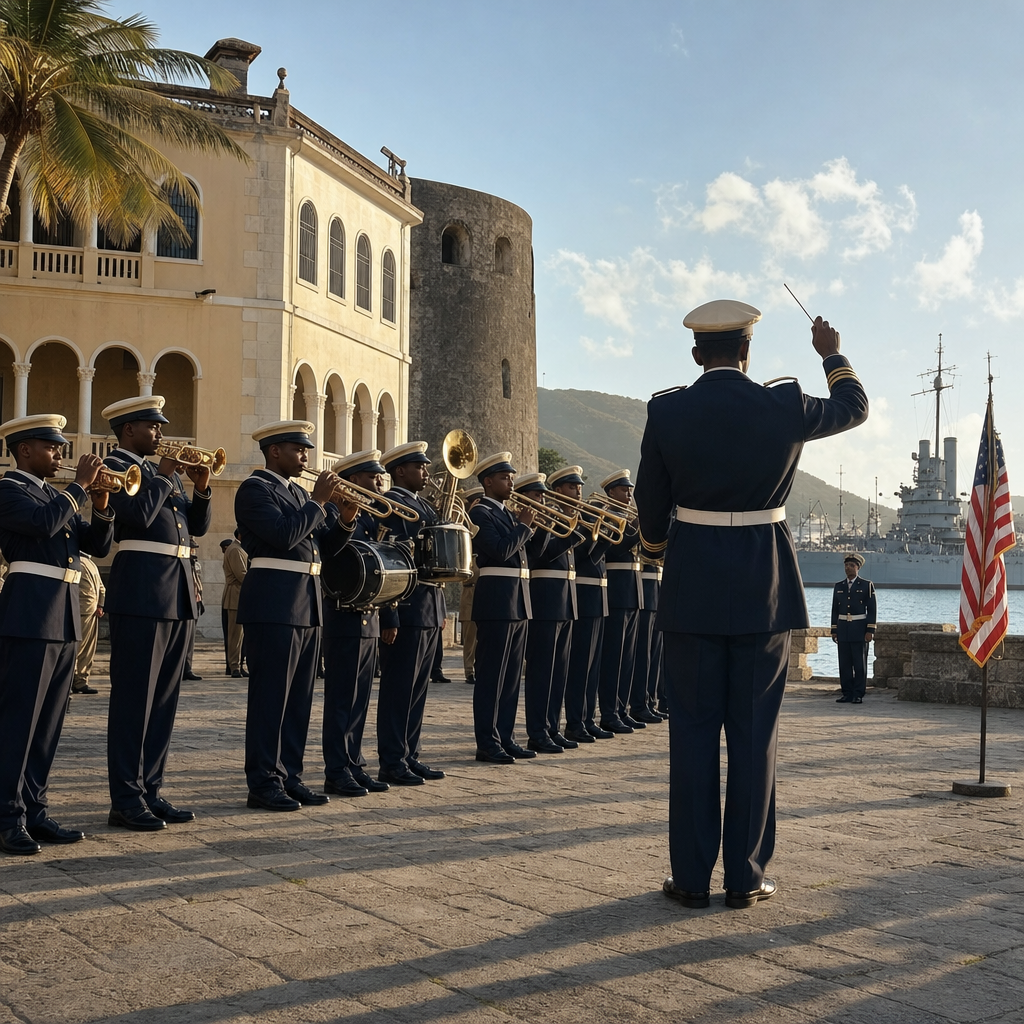
Alton Augustus Adams Sr. was patient enough, and cheerful enough, to believe in that noise. Born on St. Thomas on November 4, 1889, he was a printer, journalist, composer, and cornet player — a man with ink on one side of his life and music on the other. What he wanted was simple and ambitious: gather local boys, teach them instruments, and make a proper band out of them.
In 1910, Adams organized what became known as the Adams Juvenile Band.
The name had a funny little honesty to it. This really was a band of young people. Not seasoned professionals. Not polished visitors brought in from somewhere else. Local boys, from Charlotte Amalie, being trained by a determined island musician who took them seriously enough to expect real music from them.
Adams didn’t seem to treat “juvenile” as a warning label. He treated it as a beginning.
There must have been early sounds that needed forgiving. Any youth band has them: the note that arrives a half-step too bold, the rhythm that trips over its own shoes, the moment when a serious rehearsal briefly sounds like a parade being chased by a goat. But Adams trained them with purpose. He was not just filling time. He was building something.
Then history opened a door.
After the United States purchased the Danish West Indies, the islands were transferred on March 31, 1917. The U.S. Navy needed ceremonial music in its new territory. Instead of replacing the local musicians with a band shipped in from elsewhere, the Navy turned to the ensemble already there — the one Adams had shaped from neighborhood boys and steady practice.
On June 2, 1917, Adams and his musicians were taken into naval service as the Navy Band of the Virgin Islands.
Just like that, the practice paid off in uniform.
Imagine the change in weight: the same young musicians who had learned under Adams in Charlotte Amalie now playing for official occasions under the American flag. The same training, the same local roots, the same island sound — only now it carried a naval title. A band that had begun with boys and instruments became part of public ceremony.
And Adams stepped into history with them. He became the U.S. Navy’s first Black bandmaster, leading not an imported group but a homegrown St. Thomas ensemble. That detail keeps the heart of the story where it belongs: on the island, with the musician who had already done the patient work, and with the young players who had grown into the moment.
Adams went on to compose marches, including “The Virgin Islands March,” “The Governor’s Own,” and “The Spirit of the U.S.N.” Those titles have a fine official ring to them, the kind that sounds ready for polished shoes, straight backs, and brass catching the sun. But behind that formality is something much more human.
There was a man who believed local boys could become musicians. There were boys who practiced until the noise turned into music. And there was a moment when the wider world looked their way and found that they were ready.
What changed afterward was more than a name on a band. Adams and his musicians showed that something begun close to home could rise to meet a national occasion without losing where it came from. The Adams Juvenile Band had grown up, but it still carried Charlotte Amalie in its sound.
Not bad for youthful noise.