# The Santa Who Came Through the Airplane Hatch
The wind around a lighthouse can make even a Christmas bundle feel like it needs a seatbelt. Out in Boston Harbor, Santa didn’t arrive by sleigh or chimney. He came by small plane, with gifts packed tough enough to fall from the sky.
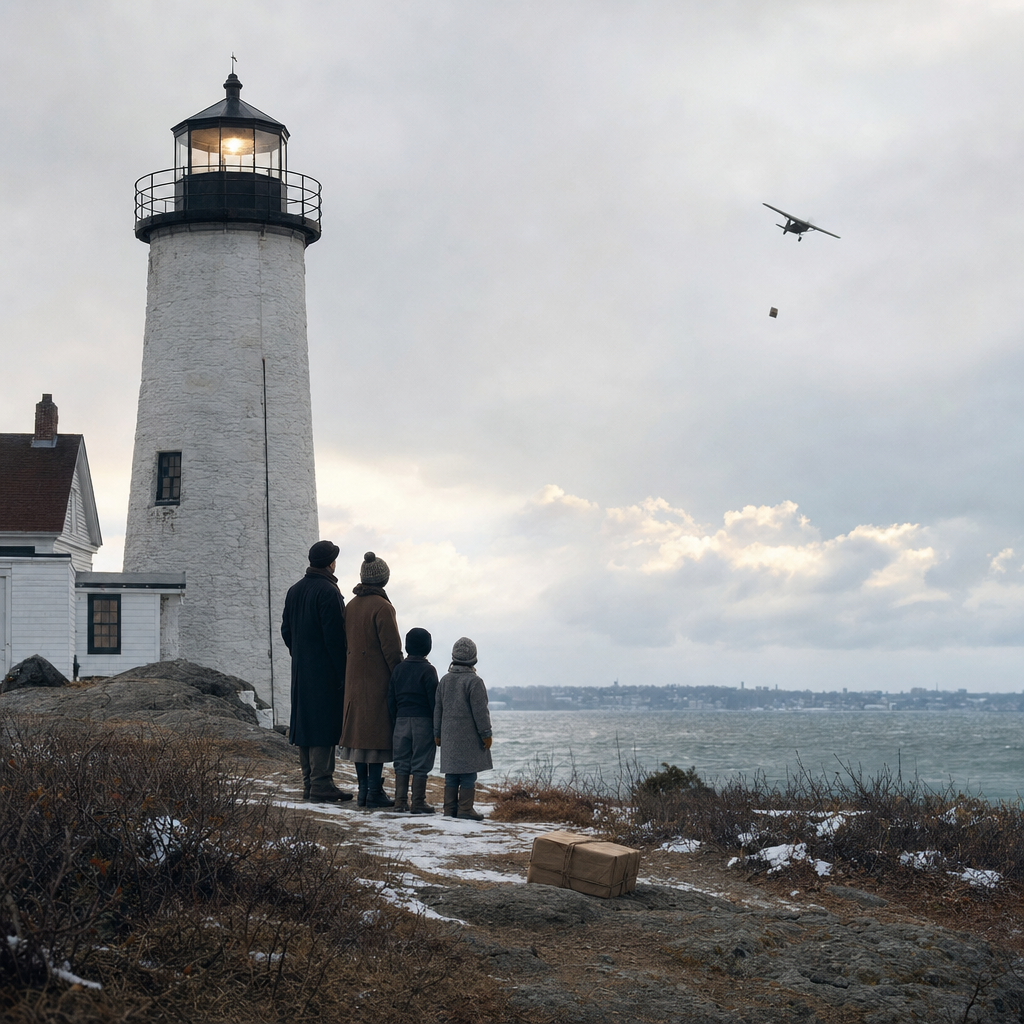
Edward Rowe Snow of Winthrop was a schoolteacher, a maritime historian, and the kind of New England character who seemed born knowing that a good errand could become a great story. What he wanted was simple: to bring Christmas cheer to lighthouse keepers and their families, people living out on lonely rocks and islands while the rest of the coast glowed with holiday windows.
In 1936, Snow took up a holiday run begun by Maine pilot William H. Wincapaw, who had first dropped gifts to isolated lighthouse keepers on Christmas Day in 1929.
There was a small plane. There were bundles. There was the weather, which in Massachusetts harbor country has never been shy about making itself part of the story. And below, in places like Boston Light on Little Brewster Island, there were lighthouse families looking up from the wind, watching for the speck in the sky.
The packages weren’t grand. They held candy, coffee, newspapers, toys, and other small comforts — the kind of things that seem ordinary until you’re far from town, surrounded by water, salt air, and a winter sky as gray as an old pewter spoon. A newspaper could carry the world to a keeper’s table. Coffee could warm a long watch. Candy could make a child grin. Toys could turn a hard, cold day into Christmas morning.
But first, the gifts had to survive the trip.
Snow’s holiday run required faith and a good deal of wrapping. There was no neat front porch, no polished brass door knocker, no chimney waiting in storybook fashion. There was an airplane hatch. There was open air. There was a drop.
It’s one of the sweeter logistical jokes in Boston Harbor history: Santa did not need reindeer after all. He needed a pilot, a plane, and someone sensible enough to secure the coffee.
You can almost see the moment. The plane comes into view over the water, its engine cutting through the cold air. Someone on the island spots it. A face turns upward. Maybe a hand lifts against the glare. The airplane circles close enough to be known, and then the bundle comes down, not like a miracle exactly, but like a very determined Christmas package with places to be.
For families at a lighthouse, the gifts were modest, but the message was enormous.
Somebody remembered you out there.
That was the heart of it. Not the candy by itself, not the coffee, not even the toys, welcome as they were. It was the strange and cheerful fact that someone had thought about the people beyond the easy roads, beyond the town centers, beyond the places where Christmas gathered in bright rooms and busy kitchens. Someone had taken the time to pack a bundle, fly it over the harbor, and send it down through the December air.
Snow kept making the flights for decades, and the errand became a Massachusetts harbor custom. He became known as the “Flying Santa,” a title that sounds half like a newspaper headline and half like something a child would announce with total seriousness while pointing at the sky.
The nonprofit Friends of Flying Santa now carries on the same idea that made those first bundles matter: small comforts can travel a long way when they’re sent with care.
Sometimes, Christmas comes with wings.