# The Man Who Saved Christmas With Nuts and Bolts
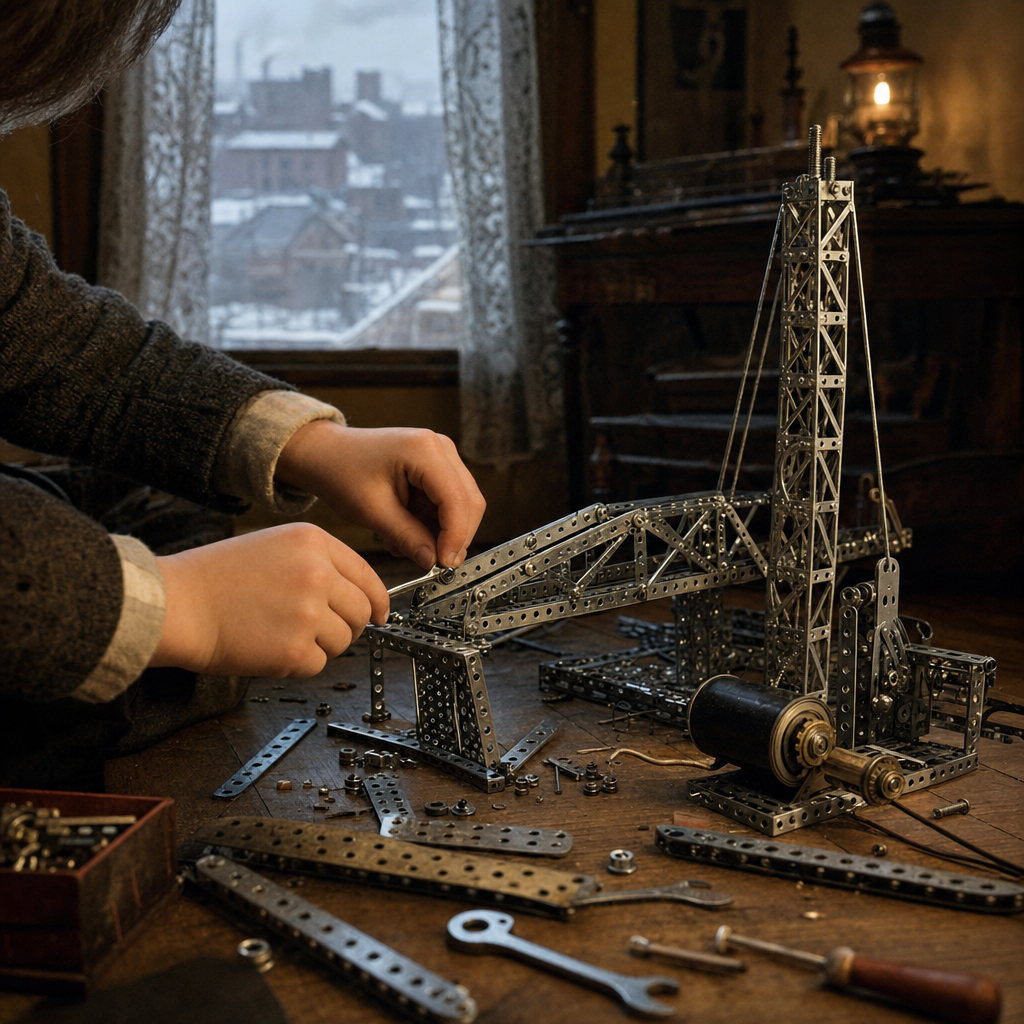
The little metal pieces must have looked almost funny in such a serious room: tiny girders, nuts, bolts, pulleys, and motors, the sort of things that could turn a living-room floor into a small, clattering engineering works.
Alfred Carlton Gilbert was used to taking big ideas seriously. He was a Yale-trained physician, an Olympic pole-vault gold medalist, and a manufacturer in New Haven, Connecticut. Near the end of World War I, he wanted the government to understand one simple thing: toys mattered.
Gilbert had introduced the Erector Set a few years earlier, after watching steel towers rise along the New Haven Railroad line. Where someone else might have seen only construction, he saw possibility in miniature. The same straight lines, braces, angles, and bolts that held up the modern world could fit in a child’s hands.
By the end of the war, his A.C. Gilbert Company was making those metal construction toys in Connecticut. But wartime brought a grown-up worry. The U.S. Council of National Defense was considering whether toy production should be curtailed so materials and factory capacity could be saved for more urgent needs.
On paper, that sounded sensible. Toys could look like extras. Frills. Nice things, perhaps, but not necessary things.
Gilbert disagreed.
So he went to Washington with the best argument he had: the toy itself. Not a long speech wrapped in fancy language. Not just charts or figures. His exhibit was something a child would have understood immediately. Here were the little metal strips. Here were the fasteners. Here were the pulleys and motors. Here was a set that didn’t simply ask a child to watch, but to build.
There is a small smile tucked inside the scene: a man with a medical degree and an Olympic gold medal standing before federal officials to defend the national importance of play. That is a very respectable résumé for a man about to make a case for a box of nuts and bolts.
But the point was not silly at all.
The Erector Set wasn’t only something to keep children busy while adults got on with serious matters. It invited them to make bridges, towers, machines, and moving parts. It gave them permission to tinker. It made the invisible logic of buildings and railroads small enough to hold.
A child could tighten a bolt and feel a little bit of the world make sense.
That was the turn in Gilbert’s argument. He was not asking officials to protect amusement for amusement’s sake. He was asking them to see imagination as useful, and play as one way children practiced becoming capable. A little box of metal strips might not look important next to the needs of a nation at war, but in Gilbert’s hands it became a promise: give children tools, even toy tools, and they may start dreaming in beams and wheels and working parts.
His argument carried the day. The proposed restriction was dropped.
Newspapers later gave Gilbert a cheerful nickname: “the man who saved Christmas.” It fit him neatly, not because he had waved away hardship, but because he had made room for wonder in a season when practical people were counting every resource. The Erector Set went on to become one of America’s classic toys and was inducted into the National Toy Hall of Fame in 1998.
In New Haven, the former A.C. Gilbert factory complex still survives as Erector Square, the place where a practical Connecticut inventor helped make room for imagination.
Some victories come with a satisfying little click.