Mark Twain’s Nevada Newspaper—and the Camel Race That Came True
The San Francisco Chronicle first treated Richards’s 1959 report as true, then challenged him to stage the race. In 1960, two zoo camels made the joke real.
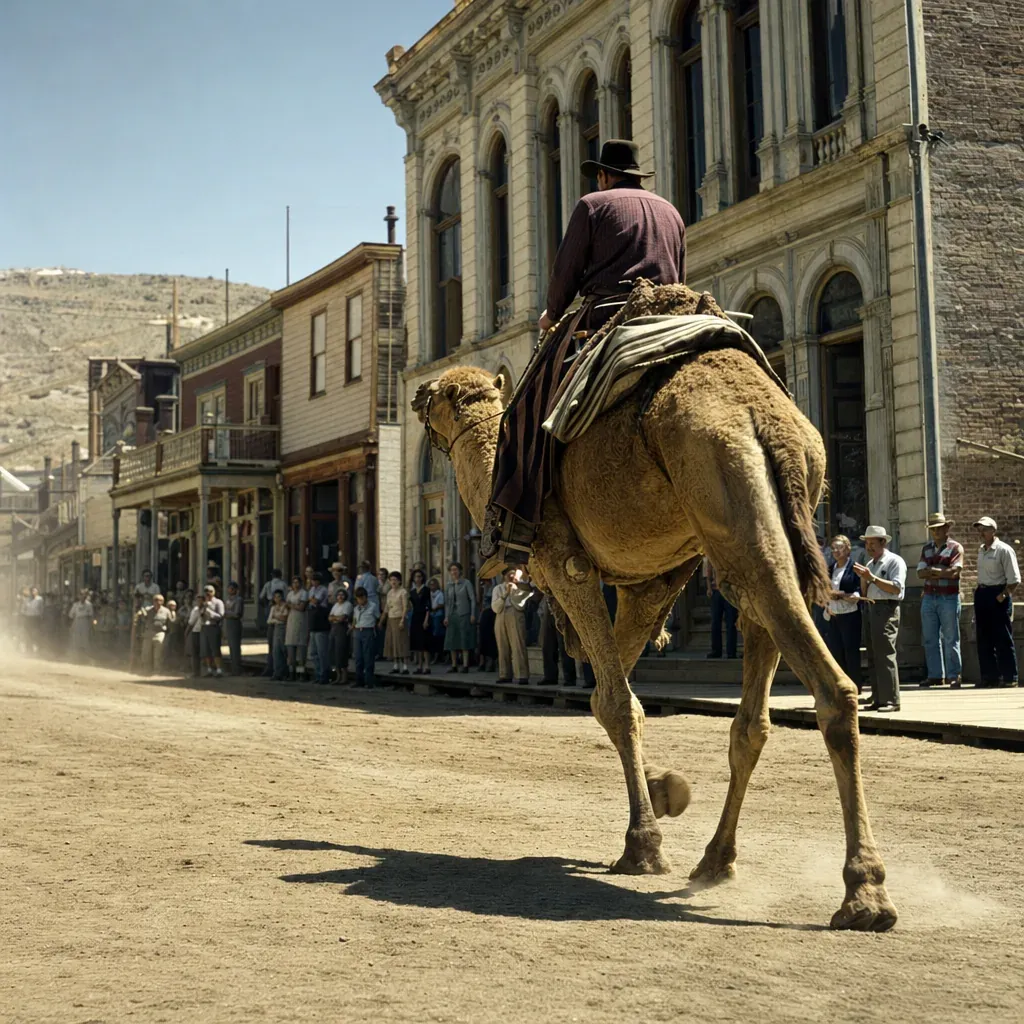
In 1959, Bob Richards put a camel race down Virginia City’s main street on the page, though no one had seen a camel in town for more than 80 years. As editor of the Territorial Enterprise, Richards was known for frequent flights of fancy. Local readers recognized the tone and did not take his fictitious race seriously. The joke depended on that gap between a familiar editor’s invention and the unlikely animal at its centre.
The San Francisco Chronicle picked up the story as true. When the paper realized it was a farce, it challenged Richards to hold the race and offered to compete. Richards wrote of an upcoming race the next year, and the Chronicle took up the challenge. A printer’s joke had acquired a date and a rival. The turn was not that readers suddenly believed in camels on Virginia City’s streets; it was that the Chronicle’s response pushed a made-up race toward a real one.
Richards could have left the matter there. Instead, the Chronicle was joined by the Phoenix Gazette and the Indio, California Chamber of Commerce. The San Francisco zoo supplied two camels, which were trucked to Virginia City. There was no longer any need to imagine the animals: an idea meant for a newspaper column now had actual camels on the way.
The first Virginia City Camel Race took place in 1960 on B Street, in front of Piper’s Opera House. The location sounded more stately than the premise, which was part of the fun. John Huston rode for the Chronicle. He had never been a jockey, but won the race on the winning San Francisco camel, Old Heenan.
Huston credited his win to “my deep understanding of the camel.” It is a compact explanation, and the camel, at least, had no need to correct him.
Richards had set the story in motion, but the result was no longer his alone. The paper had written a race into being; rival newspapers and a chamber of commerce joined in, and zoo camels carried the gag from print to B Street. The premise was absurd. The arrangements were real.
Virginia City had a history with newspaper names that travelled. Samuel Langhorne Clemens arrived in Nevada with his brother Orion, who had been appointed secretary to the territorial governor. After a brief stint as a miner, Clemens became a reporter for the Territorial Enterprise in 1862. In 1863, he filed a story under the name “Mark Twain.” The phrase came from the Mississippi River, where it meant two fathoms of water—just barely safe for a steamboat.
Clemens’s route west began when his river days ended with the start of the Civil War. He and Orion travelled by stagecoach to Carson City. Mining did not hold Clemens; after his brief stint, he returned to writing at the Enterprise as a reporter in August 1862. In December 1864, Twain left for California to begin work with the San Francisco Call. Over the next five decades, he published more than thirty books and pamphlets and wrote more than three thousand newspaper and magazine articles.
Clemens’s career and Richards’s camel race were different kinds of newspaper history. One pen name went on to be known around the world; the other editor’s fictitious race left the page and became an annual event. But both stories began in the Enterprise’s columns, where a few words could set something larger in motion.
The phrase “Mark Twain” named a depth where a steamboat could just pass. Richards’s joke crossed a different threshold: local readers understood it as fiction, while the Chronicle answered in a way that made a real race possible. The printed story did not become true in the usual sense. Its details changed into something people could see: competitors, camels and a course on B Street.
In 1962, the camel race course moved permanently to E Street near the old railroad depot. Ostrich racing was added, and the lark grew into an annual event attracting thousands of spectators. What started as a newspaper farce kept changing shape: a race, a course, then a gathering with camels and ostriches in the mix.
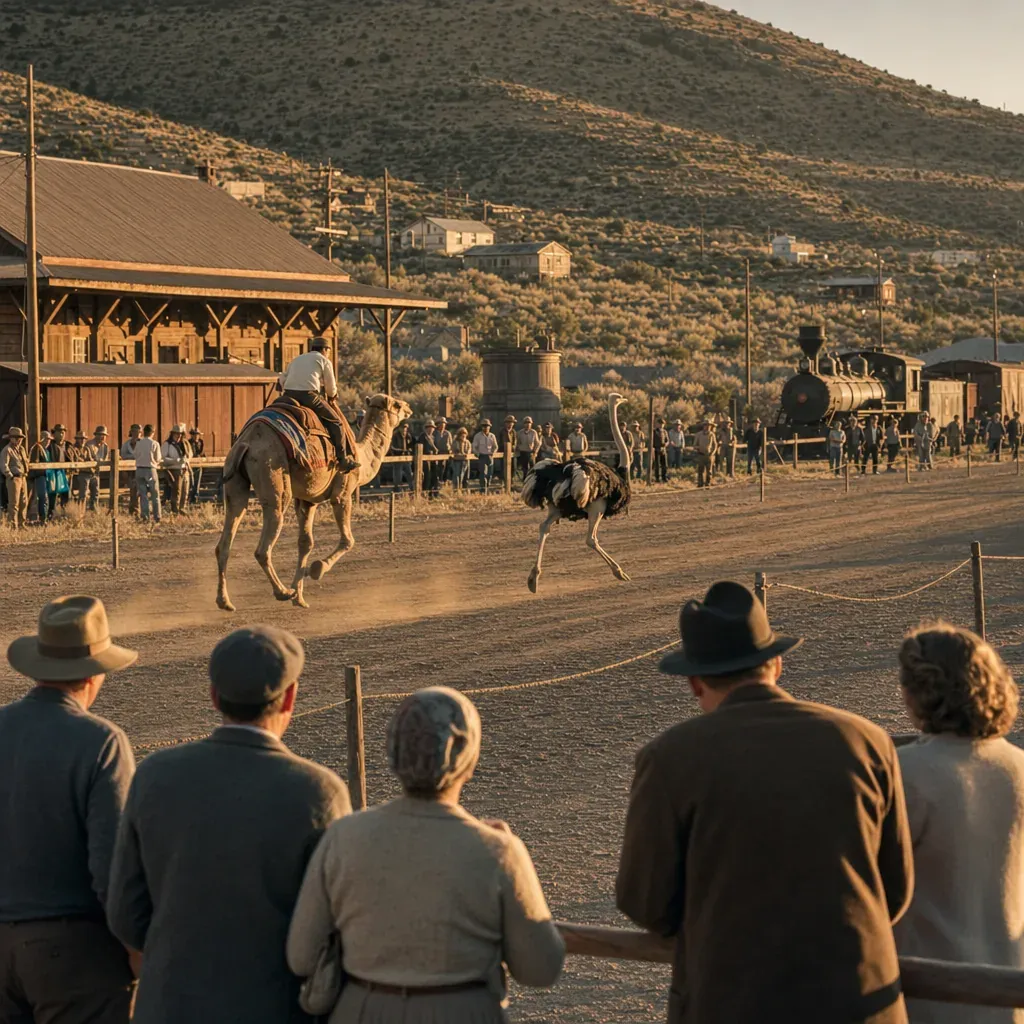
The modern event has widened the cast again. The 67th International Camel & Ostrich Races promised camels, ostriches and even zebras carrying daring riders across the finish line at a family-friendly event. Its program was four shows over three days: Hot Camel Nights on Friday from 5 to 7 p.m., two Saturday shows at 10 a.m. and 2 p.m., and a Sunday Family Day show at noon, when the first 100 children could ride a camel for free. That was the program for the 67th event, not a standing schedule.
For its 67th edition, the races were scheduled at Virginia City Fairgrounds, 435 L St, Virginia City, NV 89440. The address belongs to that edition; the original races ran on B Street by Piper’s Opera House before the course moved to E Street in 1962. The locations mark how far the gag travelled—from one newspaper’s idea to a race that found a home of its own.
Richards’s local readers had understood the joke from the start. The Chronicle’s challenge gave it a second act, and the camels made that act possible. Huston’s winning line still fits the whole enterprise: “my deep understanding of the camel.” It is hard to improve on a joke that managed to become a race without losing its silliness.
Listen to this story, narrated.
Sources
- Twain’s Timeline — The Mark Twain Boyhood Home & Museum
- Documenting Mark Twain — National Endowment for the Humanities
- Nevada Magazine, Sept/Oct 1987 PDF — Nevada Magazine / Nevada State Library, Archives and Public Records
- The most ridiculous, hilarious, over-the-top Bay Area hoaxes ever — SFGATE
- International Camel & Ostrich Races — Virginia City Tourism Commission