The Tabernacle Choir Broadcast Began with a 19-Year-Old on a Ladder
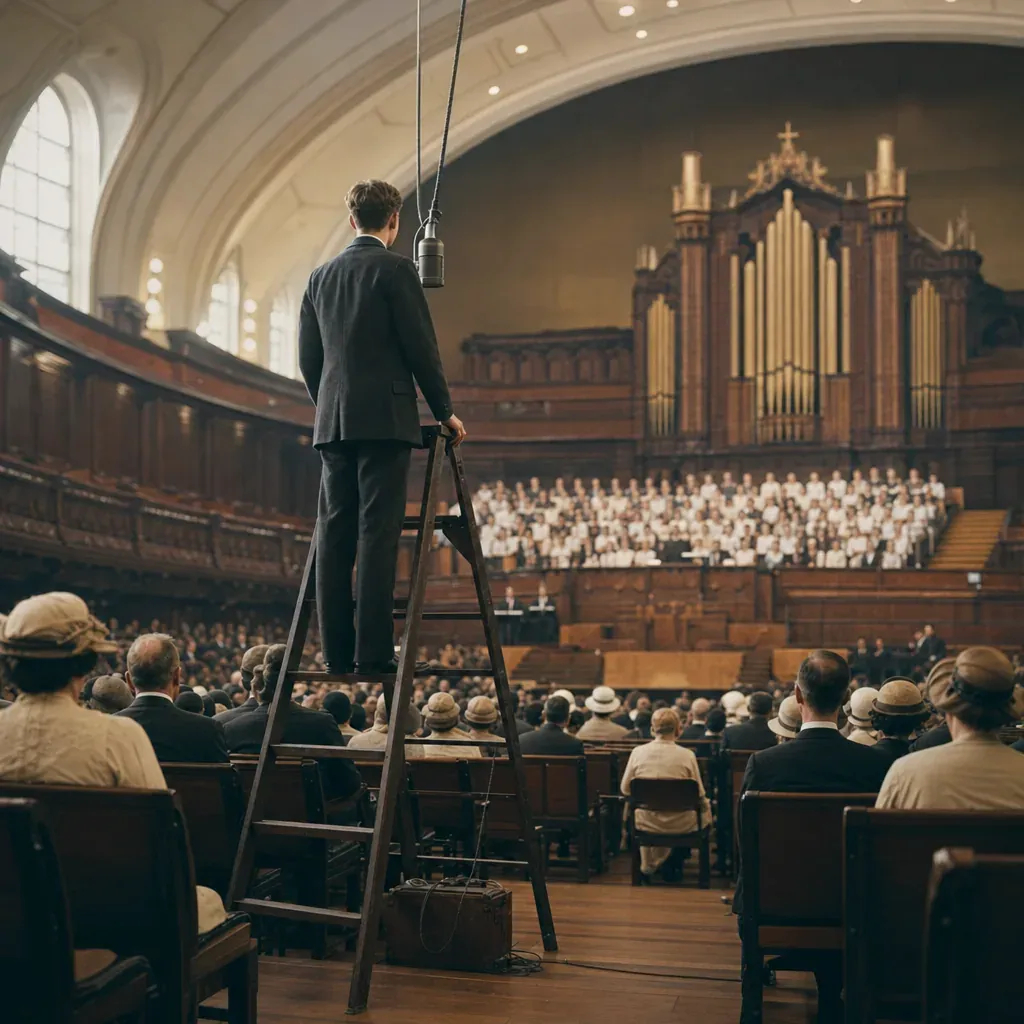
Before the choir’s music could reach homes beyond Utah, a 19-year-old had to climb a ladder. Not for decoration, not for drama, but because the microphone was up there. Ted Kimball was in the Salt Lake Tabernacle, the son of Edward P. Kimball, the Tabernacle organist. He wasn’t there to conduct, play, or sing with the great choir filling that famous oval hall. He had a smaller job: announce the musical numbers clearly enough for radio listeners to follow along. The Sunday was July 15, 1929, and KSL Radio was carrying the first broadcast from the Salt Lake Tabernacle. Anthony C. Lund conducted the choir. Edward P. Kimball sat at the organ. Ted, young enough that the scene still feels a little like someone’s helpful son being drafted at the last minute, stood on a ladder beneath a single suspended microphone. The setup was practical, not glamorous. The microphone had been hung high so it could gather the sound of the choir and organ in that remarkable space. But a microphone high enough to catch all that music was also, inconveniently, high enough that a person speaking into it needed a boost. So up went Ted. Picture the room in that first broadcast moment: the choir ready, the organ waiting, the quiet rustle before music. Then Ted, balanced above the floor, close to the microphone, doing the simple human thing new technology so often requires. Somebody had to make it work. Somebody had to lean in and say what came next. There’s something sweetly funny about it. A broadcast that would become known around the world began not with a sleek studio or a polished announcer’s booth, but with a teenager on a ladder, making himself useful. The great oval Tabernacle, the choir, the organ, the radio signal — and there in the middle of it all, a ladder doing its part. No one needed to make the scene grander than it was. The choir sang. Edward P. Kimball played. Anthony C. Lund conducted. Ted announced the numbers from his perch. Through KSL, the music left the Tabernacle and reached people who were not sitting in those benches, people listening from kitchens, parlors, and radios far beyond Salt Lake City. The program continued to grow. It soon became Music & the Spoken Word, and Richard L. Evans joined as announcer in 1930. What began with one microphone, one ladder, and one young man trying to be clear became known as the longest-running continuous network broadcast in the world. The beginning is worth keeping because it feels so human. Before the polish, before the long reach, before the name became familiar to listeners far away, there was Ted Kimball looking up at a microphone and doing what needed doing. Sometimes history starts with someone steadying their feet on a rung.